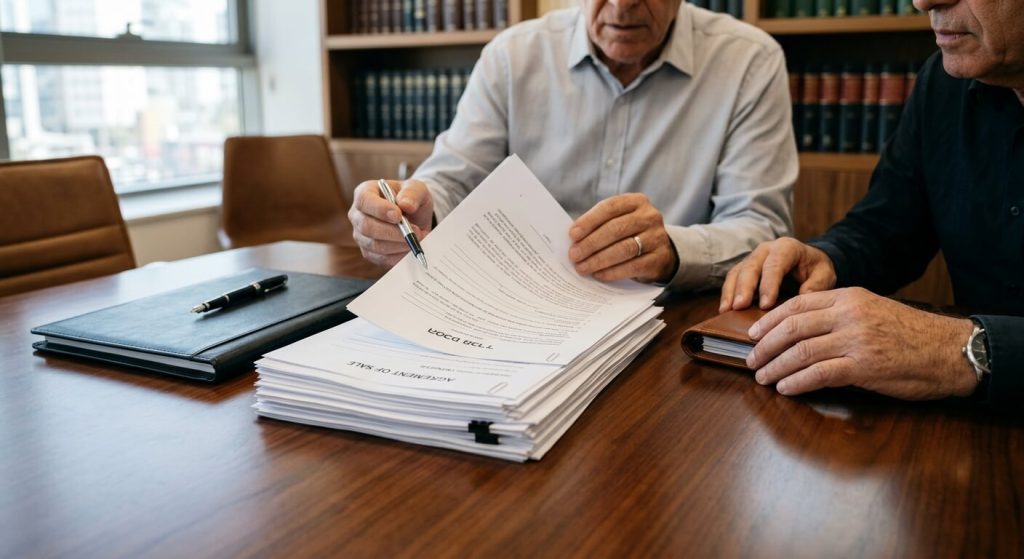
A will is a legal document in which a person expresses their wishes for how their property will be distributed after death. However, a will does not always reflect the testator’s wishes freely and without outside influence. Sometimes there are exceptional circumstances in which it is appropriate to file an objection to a will and ask the court to invalidate it. Invalidating a will is a complex and delicate legal move, in which one must prove that the will is not legally valid – whether because of a technical defect, the circumstances in which the document was prepared, or the testator’s condition at the time it was made.
In this article we review what it means to invalidate a will, when an objection can be filed, the various grounds for invalidation, and how the legal process is conducted in the Family Court.
What Is Invalidation of a Will?
Invalidating a will is a legal action taken by the testator’s heirs after the testator’s death, in which they claim that the will was not executed properly and/or does not reflect the true wishes of the deceased.
The legal basis for invalidation is set out in the Succession Law, 5725-1965, which defines when a will is valid and the conditions for invalidating it.
When Is an Objection to a Will Filed?
An objection to a will is filed when an application for a probate order is submitted to the Registrar of Inheritance – this is the stage at which potential heirs who believe there is a defect in the will can file a reasoned objection.
The deadline for filing an objection is within 14 days of the public notice of the application for probate of the will. It should be noted that an objection must be based on a legal ground, and not merely on a feeling of having been treated unfairly.
The Various Grounds for Invalidating a Will:
1. Lack of Capacity of the Testator
For a will to be valid, the testator must be legally competent at the time it is made – that is, an adult, of sound mind, who understands the meaning of the act. If the testator was under the influence of mental illness, dementia or severe cognitive decline, it is possible to argue that the will should be invalidated for lack of capacity. A medical opinion attesting to the testator’s medical and mental condition at the time the will was made will be essential evidence to prove this claim. Therefore, where there is doubt about the testator’s cognitive capacity, it is advisable to obtain a medical opinion.
- This is pursuant to Section 26 of the Succession Law, 5725-1965, which provides: “A will made by a minor or by a person who has been declared legally incompetent, or made at a time when the testator did not know how to discern the nature of a will – is void“.
- Mental Illness–
o The case law holds that the existence of a mental illness alone is not enough to invalidate a will. It must be proven that there is a causal link between the mental illness and the content of the will, and that the illness impaired the testator’s ability to discern the nature of a will at the time it was made.
o Family Appeal (Haifa) 67590-12-20 Technion – Israel Institute of Technology v. L. (decided 30/06/21). The court annulled the will after it was determined that the testator suffered from a mental illness (paranoid schizophrenia), was hospitalized several times involuntarily, and was under psychiatric supervision. It was held that at the time the wills were made, the testator was not competent to discern their nature due to impaired judgment and a distorted perception of reality. At the time the wills were made, the testator was not competent to discern their nature due to impaired judgment and a distorted perception of reality.
o Estate Case (Haifa) 161-05-12 v. L. v. (decided 15/08/16) • The court emphasized that even a person in a psychotic state may be competent to make a particular will, and this depends on the type of psychosis and its relationship to the will. Proof is required that the mental illness distorted the testator’s rational judgment to the point that the ability to discern the nature of a will was taken from him.
o Estate Case (Be’er Sheva) 37947-07-14 Y.Z. v. Sh.Z. (decided 25/03/18) • The court emphasized that proof of the existence of a mental illness alone is not enough to lead to the invalidation of a will. It must be proven that there is a causal link between the mental state at the time the will was made and the content of the will itself.
- Cognitive Decline
o Estate Case (Ashdod) 43754-07-20 D.S. v. T.D. (decided 22/05/22) • The court annulled the will after it was proven that the testatrix suffered from significant cognitive decline that developed into dementia, and that she was not competent to make the will. In addition, the deceased was not aware of the extent of her property and did not understand the meaning of excluding her son from the will, which led to the annulment of the will.
· Tests for Determining Whether the Deceased Understood the Act of Making the Will (a Condition for the Testator’s Capacity)-
o Estate Case (Tel Aviv) 8896-02-13- L.K. v. A.G. (decided 24/05/2017) “In order for a testator to be considered as one who is able to discern the nature of a will, ‘. . he was capable of all of the following: (a) to remember the extent of his property; (b) to understand that by the act of making a will, he grants another person the right to receive his property after his death; (c) to remember and understand that he has other relatives who, but for the will, would have been considered heirs, and that by his act he is excluding them from the inheritance.'”
2. Undue Influence
When a person is acted upon by pressure, manipulation, fear, dependence or control by another person – and the will is written under that influence – it can be argued that it does not reflect their true wishes. The influence is examined according to tests established in the case law, such as the level of dependence, isolation from the family, the extent of the beneficiary’s involvement in making the will, and more. Such cases are common when a caregiver or a particular family member benefits unusually from the will.
- Normative Framework:
Section 30(a) of the Succession Law: “A provision of a will made by reason of duress, threat, undue influence, trickery or fraud – is void”.
- The Four Tests (Not All of Which Must Be Met) for Determining Undue Influence: (Further Civil Hearing 1516/95 Marom v. Attorney General, IsrSC 52(2) 813 (1998))
o Introduction: For purposes of recognizing the existence of undue influence, it is not necessary that all of the tests detailed above be met. In fact, the existence of some of the said tests is sufficient to indicate the existence of such influence, and at the same time the court may use additional tests in reaching its decision.”
o The Dependence and Independence Test– Whether, during the period relevant to the making of the will, the testator was independent physically and mentally-cognitively, and to what extent. This test examines the degree of the testator’s independence both physically and mentally-cognitively. The more independent the testator was, the stronger the tendency to rule out the existence of dependence on the beneficiary.
o The Dependence and Assistance Test– The court will tend to find that the testator was dependent on the beneficiary if it was the beneficiary who helped the testator overcome his difficulties and limitations.
o The Test of the Testator’s Relationships with Others– The testator’s isolation and disconnection from others increase his dependence on the beneficiary, where the reason for the disconnection and isolation is not relevant. The more it becomes clear that during the period relevant to the making of the will the testator was completely cut off from other people, or that his contacts with others were few and rare, the stronger the presumption that the testator was indeed dependent on the beneficiary.
o The Test of the Circumstances of the Making of the Will
- Situations in Which the Will Was Annulled Due to Undue Influence:
o Estate Case (Tel Aviv-Jaffa) 34123-10-11 H. Sh. v. A. Sh. (decided 19/06/2017) • H. was actively involved in making the will, including ordering a psychiatric opinion, and was present around the deceased at critical times. In addition, H. exploited the deceased’s medical condition to transfer large sums of money to his personal account.
o Estate Case (Tiberias) 52171-08-16 xxx v. xxx (decided 12/11/2023) due to the deceased’s poor physical and mental condition, her dependence on the brothers and her distancing from the sister.
o Estate Case (Be’er Sheva) 12529-04-21 Jane Doe v. John Doe (decided 01/07/2024) The court accepted the objection to the probate of the will after finding prima facie evidence of undue influence by the applicant over the deceased. The deceased described the applicant (in a previous legal proceeding conducted in the Magistrate’s Court in 2015, when the deceased himself initiated a proceeding to cancel a gift agreement in which he had transferred his apartment to the applicant) as someone who had exploited and cheated him, and he was dependent on her.
- Situations in Which the Will Was Not Annulled Despite Suspicion of Undue Influence:
o Estate Case (Tel Aviv) 19295-07-20 Ts.V. v. A.M.V. (decided 20/08/24)- The court emphasized that there is nothing improper in trying to influence a person to write a will in his favor or in favor of another. What is improper is only undue influence. The burden of proof rests on the one claiming such influence.
o Estate Case (Safed) 60599-02-22 L.A. v. Sh.L.R. (decided 12/03/24)- The court rejected the objection to the will and held that the deceased was independent in his actions, maintained contact with other family members, and that his isolation was not proven. The will reflects his life story and preferences.
o Estate Case (Krayot) 31161-07-21 In the matter of the estate of the deceased P.Y. (decided 30/10/24)- The court rejected the claims of undue influence and held that although the deceased were dependent on their children, they maintained contact with their grandchildren and the wills reflect their free will.
o Estate Case (Be’er Sheva) 70508-12-18 D. v. the Public Guardian (Administrator General) in the Southern District (decided 01/02/22). The court rejected the claims of undue influence and held that the deceased was a functioning and independent person. The objectors did not succeed in proving the cumulative existence of the four touchstones established in the case law.
3. Formal Defect in the Will
Every will must be made in accordance with the rules set by law, according to the type of will: handwritten, before witnesses, before a notary or oral. Technical defects such as the absence of a signature, the absence of witnesses, etc. – may lead to its invalidation. There are cases in which a formal defect can be “cured” if certain conditions are met, but sometimes the defect goes to the very substance of the will’s validity.
Normative Framework: Section 25 of the Succession Law:
o “Where the basic elements of a will exist, and the Registrar of Inheritance or the court, as the case may be, has no doubt that it reflects the free and true wishes of the testator, it may, in a reasoned decision, probate it even if a defect occurred…”
Case Law in Which the Will Was Annulled Due to a Formal Defect-
o Estate Case (Tel Aviv) 45121-02-19 A.B. v. G.D. (decided 16/04/2023) – In this case the court annulled the will after finding significant formal defects:
§ Absence of a statement by the witnesses that the deceased declared before them that this was her will
§ The witnesses signed at a later date than the deceased’s signature
§ It was not proven that the will reflects the true and free wishes of the deceased
Case Law in Which the Will Was Not Annulled Despite a Formal Defect-
o Estate Case (Tel Aviv) 11722-12-15 Y.K. v. A.K. (decided 02/11/2017) • The court held that even if there was a formal defect in the will due to the failure to note that the will was read to the deceased, this defect was cured under Section 25 of the Succession Law. That is, the court did not annul the will.
o Family Appeal (Haifa) 26523-10-22 A. v. B. (decided 10/01/2023) The court held that an error in the date of signature is not a formal defect that is sufficient to annul the will.
4. Forgery or Fraud
When there is a suspicion that the will was forged – whether it involves a forged signature, altered content, or a document that was not written by the testator at all – an application can be filed to invalidate the will on the claim of forgery. In such cases an opinion from a graphologist or handwriting identification expert is needed, and sometimes other supporting testimony as well. Obtaining a will by presenting a misrepresentation – for example, regarding the situation of family members – is also considered grounds for invalidation.
- Case Law That Annulled a Will Due to Forgery:
o Estate Case (Tel Aviv) 60970-09-14 A. G. v. M. H. M. (decided 22/01/17) • The court accepted the forgery claim based on an expert handwriting-comparison opinion that determined that the signatures on the will were not the deceased’s.
5. A Will Written Under a Mistake
If the testator made a material mistake about important details when writing the will – for example, was sure that a certain person had died and therefore did not include him as an heir – it can be argued that the will does not reflect his true wishes. A mistake may lead to a reinterpretation of the will or to its annulment, depending on the severity of the incorrect information.
- Normative Framework-
o Section 30(b) of the Succession Law: “A provision of a will made by reason of mistake – if it is possible to determine clearly what the testator would have directed in his will had it not been for the mistake, the court shall correct the words of the will accordingly; if it is not possible to do so – the provision of the will is void”.
- Case Law in Which the Will Was Annulled Due to a Mistake-
o Estate Case (Rishon LeZion) 2254-04-14 D.B.Sh. v. R.G. (decided 15/09/2016) • The court annulled the will after finding that it was made by reason of mistake, trickery and fraud. The plaintiff presented the deceased with a misrepresentation that he would help him recover funds that had been taken from him, but in fact did nothing in this regard.
- What Are the Types of Mistakes in a Will?
o Estate Case (Tel Aviv) 58836-03-22 Jane Doe v. John Doe (decided 30/01/2025) • The court discussed at length the issue of mistake in a will and defined three possible types of mistakes: “A mistake of fact – where there is a gap between objective reality and the testator’s subjective perception of it… A mistake of law – originates in the testator’s mistake regarding the legal meaning he attributed to the provisions of the will… A mistake of motive – is one based on an erroneous factual assumption.”
The Legal Process for Invalidating a Will:
When an objection to the probate of a will is filed, the Registrar of Inheritance transfers the file to the Family Court, where the matter is heard as a full civil lawsuit.
The Main Stages of the Process:
Filing a Reasoned Objection – including details of the ground, attaching relevant documents and expert opinions.
Response by the Party Submitting the Will – the party interested in the will being probated will file a statement of defense and may bring witnesses on its behalf.
Conducting an Evidentiary Hearing – including cross-examination of witnesses, presentation of medical and graphological opinions, presentation of additional documents, and examination of the circumstances in which the will was made.
Judgment – at the end of the process, the court will decide whether to accept the objection and invalidate the will, or to reject the objection and probate the will.
It is important to emphasize that the courts tend to respect the testator’s wishes as long as they were written properly and of free will, and therefore strong and convincing evidence must be presented in order to have the will invalidated.
Summary:
Invalidating a will is a significant legal proceeding that touches the heart of a person – their last wish. Nevertheless, in cases where a real concern arises about a defect in the validity of the will – action should be taken in accordance with the law to ensure justice and fairness among the heirs. Grounds such as lack of capacity, undue influence, forgery or material mistake may lead to the annulment of the will, but this requires professional, careful legal work backed by evidence.
If you received a probate order that you do not agree with, or you believe that an injustice was done in the will – it is recommended to turn to an attorney who specializes in inheritance law as soon as possible, and to assess the prospects of an objection in light of the specific circumstances of the case.
Drafting a will involves many important details, the absence of which could invalidate it. It is recommended to turn to an attorney or notary, who can write the will in a legal manner, will pay attention to the small details, and will prevent – heaven forbid – a dispute among the heirs, aggravation, court battles and unnecessary financial expenses. We would be happy to assist you with any question.