You can obtain a betterment levy exemption worth savings of tens to hundreds of thousands of NIS, if not millions, when selling or improving the property.
In this guide we will discuss the law, the conditions, and the ways to reduce tax liability.
What Is a Betterment Levy?
A betterment levy is a payment for an increase in value resulting from the approval of building plans, the granting of a variance, or approval of a non-conforming use. The principle underlying it is distributive justice, under which the property owner shares with the community the profit created as a result of planning decisions (half of the value of the increase). By law, these funds are intended to finance infrastructure, educational institutions, and public spaces.
Overview of the Betterment Levy Law
The legal basis is set out in Chapter 8-1 of the Planning and Building Law, Section 196A which grants the local committee the authority to collect the betterment levy and which is detailed in the Third Schedule to the Planning and Building Law, 5725-1965. In practice, this is the mechanism that determines that every time the value of land increases as a result of a planning action, the property owner is required to pay. The law sets out the rules and conditions, based on the notion that a property owner is obligated to share with the public the economic profit created for him or her, because it is the public that caused the profit.
Who Pays the Betterment Levy?
The answer depends on the identity of the holder of the rights in the property on the day the betterment-creating plan was approved, as the law imposes the obligation on the owner of the land or on the long-term lessee. For a property leased from the Israel Land Authority (ILA), the long-term lessee is the one who will bear the payment, whereas for private properties the obligation falls on the owners registered in the Land Registry (Tabu). It is important to note that in cases of a property sale, it is customary to specify in the sale agreement which of the parties will absorb the cost. It is customary to provide that if a betterment-creating plan was approved before the contract was signed, the seller will bear the cost, and if a betterment-creating plan was approved after the contract was signed, the buyer will bear the cost.
When Is the Betterment Levy Paid?
A distinction must be made between the date on which the tax liability arises and the date on which it must be paid. The tax liability arises on the day the betterment-creating plan is approved by the planning committee, but payment is generally deferred until the time of its “actual realization,” and under Section 1(a) of the Planning and Building Law, 5725-1965, this is one of the following situations:
1) Receipt of a permit
2) Commencement of use
3) Transfer of rights
That is, upon the sale of the rights in the property, or upon submission of an application for a building permit that utilizes those new rights, or upon actual use after the permit is received.
It is important to remember that despite the deferral, the amount of the levy is linked to the Consumer Price Index or to the construction input prices index, whichever is lower, from the date the plan was approved until the day of actual payment. In cases of late payment, arrears interest may also be added, and under Section 9 of the Planning and Building Law, 5725-1965.
Betterment Levy Exemption
There are several cases established by law that allow property owners to obtain an exemption from the betterment levy, thereby reducing costs in real estate transactions or construction processes. The best-known exemption is granted for expanding a residential apartment or building a new apartment, provided that the total area of the apartment after the expansion does not exceed 140 sq. m. and the owner lives in it for at least four years, as provided by Section 19 of the Planning and Building Law, 5725-1965.
In addition, the law defines entitlements that include an exemption:
- For the construction or expansion of educational, cultural, religious, and welfare institutions that operate on a non-profit basis.
- For properties located in neighborhood rehabilitation areas.
- For making buildings accessible to people with disabilities.
- For strengthening buildings against earthquakes (TAMA 38, National Outline Plan 38).
It is important to consult a real estate attorney who will examine each case on its merits before the local committee, since meeting the conditions is the key to actually realizing the entitlement.
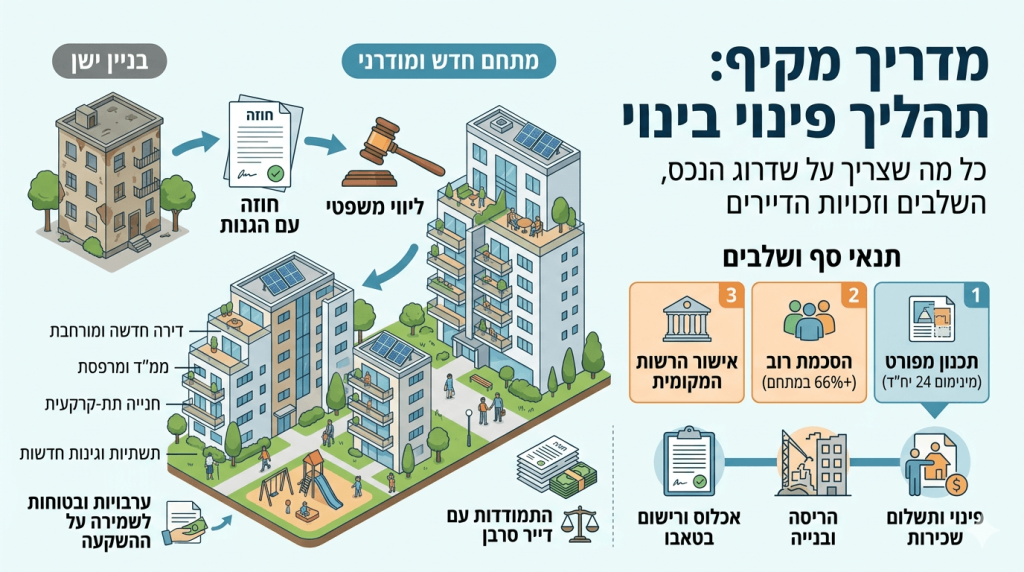
Betterment Levy Exemption in Pinui Binui (Urban Renewal: Demolish and Rebuild)
Granting an exemption from the betterment levy is one of the tools intended to encourage urban renewal projects, out of an understanding that without these concessions, many deals would not be economically viable for the developers and the residents. In these projects, the law allows granting an exemption from the betterment levy, but obtaining it is subject to meeting planning conditions. It is important to note that the local authority has the authority to decide on the amount of the exemption – whether to grant a full exemption, a 50% exemption, or to collect a regular levy – according to considerations of public needs versus the viability of the project.
In summary,
Eligibility for a betterment levy exemption requires a precise legal examination and advance tax planning. Professional legal guidance before the local committee will ensure that you do not pay a single shekel more than the law requires and will allow you to complete the transaction with peace of mind. We would be happy to be at your service with any question. The office of Limor Galanti-Yerushalmi, Attorney and Notary.