Those who begin a Pinui Binui (urban renewal: demolish and rebuild) process enjoy new infrastructure, gardens, and public buildings. This is a multi-stage project that directly affects the value of your property. A real estate attorney will ensure that you face the developer and the authorities with a contract that protects you and guarantees that safeguard your investment.
Pinui Binui – What Do You Need to Know?
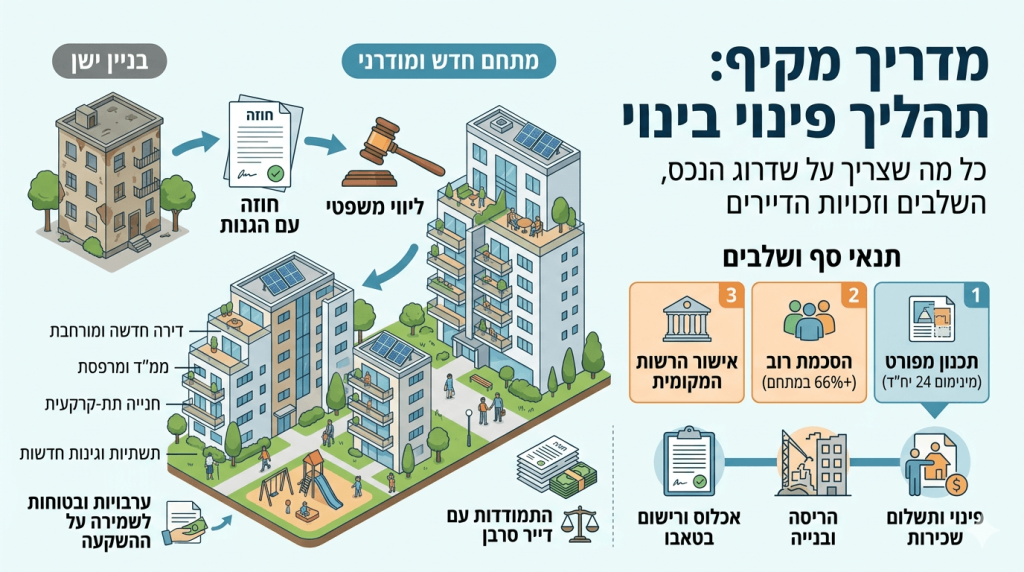
For a building to be officially recognized as Pinui Binui and to qualify for incentives, it must meet three threshold conditions set by the legislature:
- There must be a detailed plan that has been deposited with the planning committees. The plan must address the demolition or upgrade of at least 24 existing housing units, in place of which at least 70 new apartments will be built, and under Section 14 of the Government Urban Renewal Authority Law, 5776-2016.
- Pinui Binui agreement signed between the developer and a majority of the apartment owners, requiring the consent of at least 66% of the rights holders in the complex, and a minimum of 60% in each building, under Section 1 of the Pinui Binui (Encouraging Pinui Binui Projects) Law, 5766-2006.
- The project must obtain the consent of the local authority (municipality) or the city engineer.
- However, there are exceptional cases, established in the 2023 amendment to the Government Urban Renewal Authority Law, that allow a complex to be declared even without the consent of the local authority, subject to certain planning conditions, but even in these cases there may be situations in which the consent of the local authority is still required
Only meeting these conditions makes it possible to move forward to the implementation stages. It is recommended to verify, through a Pinui Binui attorney, that the complex does in fact meet these criteria in order to avoid unnecessary delays.
The Pinui Binui Process – Stages
To turn an old building into a new and modern residential complex, one must go through a track that includes planning, signing, and implementation stages, which require patience and precise legal guidance.
Planning Stage: Zoning Plan (TABA) Approval
This is the stage in which the building rights and the vision of the project are determined with the planning institutions. The developer submits a zoning plan (TABA) to the Local Planning and Building Committee, detailing the number of floors, the public areas, and the infrastructure that will be built in the new complex.
Choosing a Developer and Signing a Pinui Binui Agreement
At this stage the residents, through the building committee and the attorney representing them, choose a developer and negotiate the compensation. The main focus here is the signing of a detailed Pinui Binui agreement which regulates bank guarantees, the rental of an alternative apartment, timetables, and the technical specification of every new apartment in the project.
Implementation Stage: Demolition and Reconstruction
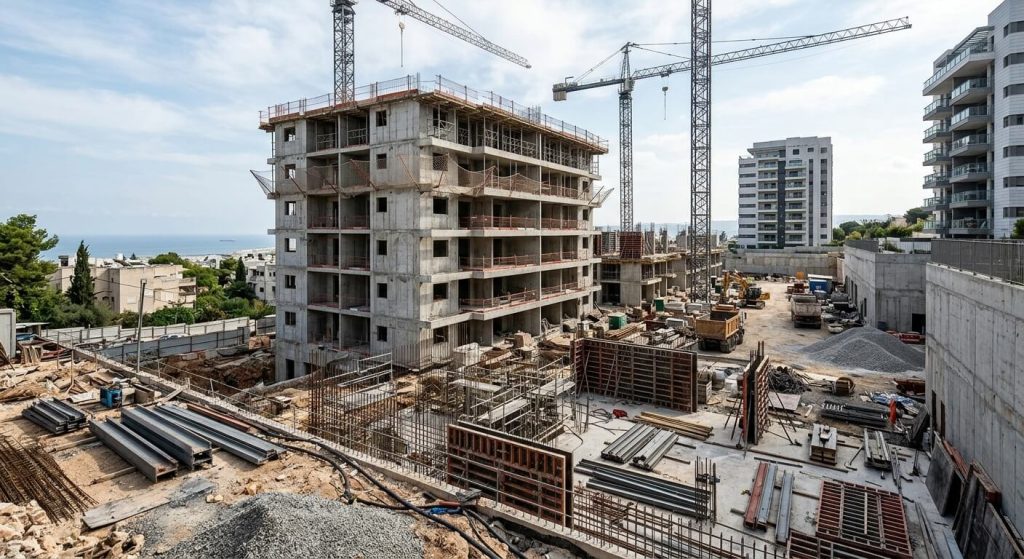
After receiving the building permit, the residents vacate the complex, and then demolition and construction of the new complex begin, while the developer pays the residents monthly rent and covers moving expenses.
Occupancy and Land Registry (Tabu) Registration
Upon completion of construction, the residents receive the key to the new apartment. The process is officially completed only after the condominium and the new apartments are registered in the Land Registry in the names of the property owners. This stage ensures that the property is registered lawfully and in accordance with the agreement reached with the developer.
What Should Be in a Pinui Binui Agreement?
As part of the agreement, it is mandatory to define a Sale Law guarantee and a bank guarantee for rent, in order to secure your property in any scenario. In addition, this agreement must include timetables, supervision mechanisms that will maintain construction quality, and when it can be canceled in the event that the project does not progress as planned. A Pinui Binui attorney will make sure that your interests come first.
Pinui Binui – What Do You Get?
The answer lies in upgrading quality of life and property value at no cost to you. As part of the project, you are entitled to compensation anchored in the agreement with the developer, such as:
- A new apartment that includes additional area (usually up to 12 sq. m.), a safe room (mamad), and a sun balcony.
- Private underground parking and an attached storage room.
- Full financing of rent throughout the entire construction period, including payment for round-trip moving.
- An earthquake-resistant building, with a lobby and an elevator.
How Long Does the Pinui Binui Process Take?
Between 10 and 15 years on average. The realistic timeline is divided into the planning and permit stage, which can take about 5-7 years, up to the actual construction stage after demolition, which takes about 3 to 4 more years.
Holdout Tenant Lawsuit
The law provides that a project cannot be stopped because of unreasonable opposition, and therefore it is possible to file a lawsuit against a holdout tenant, which allows a claim for damages for the economic harm caused by the holdout. The court or the Land Registration Supervisor examines whether the refusal is substantive, such as the absence of guarantees or a material violation of rights, or whether it is an attempt to improve terms at the expense of the neighbors. In cases of holdout without legal justification, the courts are authorized to approve the transaction even without the holdout’s consent.
Court Ruling on a Holdout Tenant in Pinui Binui
In case law there are precedents emphasizing that the right to property is not an absolute right when it harms the public interest and the rights of neighbors. For example, in the case of Regina Schwartzberger v. Shalom Marin , the Supreme Court ruled in 2014 that a holdout tenant must pay damages of 400,000 NIS (a sum significantly lower than the damage she caused her neighbors, in the amount of 1,790,000 NIS) to her neighbors after she refused the project for non-substantive reasons, while determining that a “reasonable” refusal must rest on actual harm to economic viability or the absence of securities. It should be noted that the amount she was ordered to pay is in accordance with Section 3 of the Pinui Binui (Encouraging Pinui Binui Projects) Law, 5766-2006, which allows the court to determine that a holdout tenant will bear only part of the damage, if it sees that it is just to do so, taking into account, among other things, the tenant’s ability to pay.
Retaining a Pinui Binui attorney who represents the residents is an essential condition, because it ensures absolute loyalty to your interests vis-à-vis the developer. Professional representation turns the complex process into a safe and transparent one, and provides the necessary peace of mind. We would be happy to be at your service with any question.