If you live in an old building slated to undergo an urban renewal process (Pinui Binui, in which the old building is demolished and a new one is built), you are surely feeling a mix of excitement and apprehension. On one hand, you will receive a spacious new apartment with a safe room (mamad), a sun balcony, or an elevator. On the other hand, for most of you this is the most complex transaction you will make in your life. Without a Pinui Binui attorney who sees only your interests, you may run into bureaucratic obstacles, construction delays of years, or worse, a situation in which the security you received from the developer is inadequate.
What Is Pinui Binui? A Net Deal
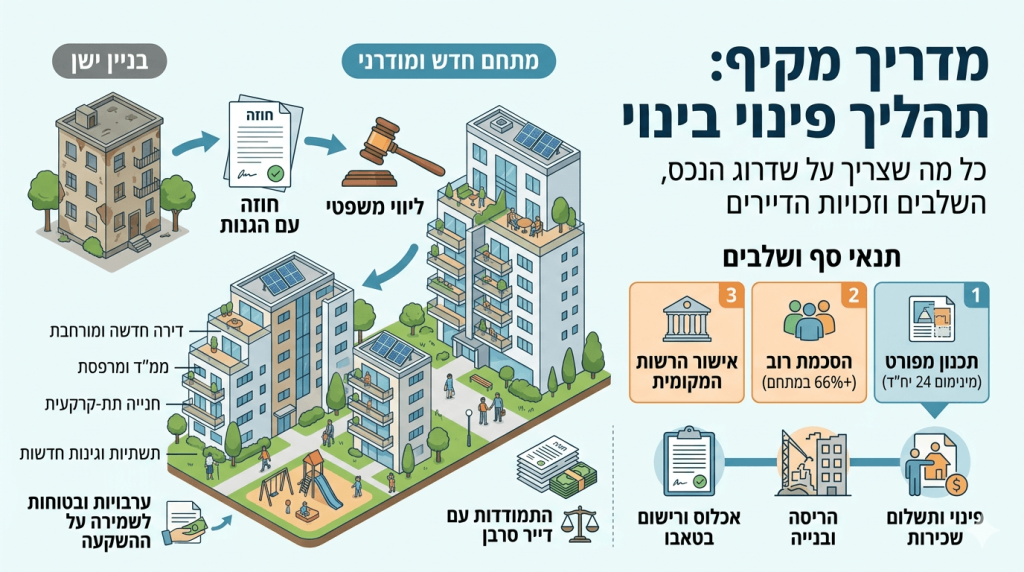
As residents, an important concept you need to know is a “net deal.” The meaning is simple but critical for you – you are not supposed to spend a single shekel out of your own pocket throughout the entire process. In a Pinui Binui transaction, you sell the developer your building rights in the land. In exchange, the developer undertakes to demolish the old building and build a new one. A net deal means that the developer bears all the associated costs:
- Your attorney’s fees.
- Land Appreciation Tax (Mas Shevach), betterment levy, and other taxes
- Planning and construction costs.
- Payment of alternative rent during the construction period, including moving expenses.
On the face of it, this sounds simple: the developer pays and you, the residents, receive. But in practice, it is more complicated. An experienced real estate attorney will make sure that the net deal is indeed absolute, with no fine print that could roll future debts onto you, and that the guarantees you receive from the developer ensure that in any scenario you have a new apartment, even if, heaven forbid, the developer runs into difficulties.
My Role as a Pinui Binui Attorney
A Pinui Binui project is a marathon. To reach the finish line, you need legal guidance that knows how to navigate between the various stations. A Pinui Binui attorney is the strategist who leads you step by step until you receive the key.
The Organization Stage
Even before meeting with the developer, you need to approach your neighbors. This is a stage in which gaps, concerns, and conflicting interests often surface. Here, the role of a real estate attorney is to help establish the residents’ representative committee. I will help form a balanced committee that faithfully represents all of the apartment owners. The goal at this stage is to form agreements and create a united front. The more united you are at an early stage, the more your bargaining power against the developers will grow significantly.
Choosing the Developer
Choosing a developer is perhaps the most fateful decision you will make. I will run a transparent and professional developer tender for you, in which we will examine in depth parameters such as:
- Does the developer have the financial backing to complete the project even in times of market uncertainty?
- Has the developer successfully completed complex Pinui Binui projects in the past?
- Do they have customer service that accompanies you?
Conducting Commercial-Legal Negotiations
After we have chosen the developer, we enter the conference room to maximize the compensation you will receive. The negotiation I conduct is twofold:
- We fight to ensure that you receive the maximum possible, such as additional square meters for the apartment, a sun balcony, underground parking registered in the Land Registry (Tabu), a storage room, and a rich technical specification.
- We make sure that everything is anchored in law, that there are autonomous bank guarantees, and that you have full protection against any scenario.
The goal is to ensure, with 100 percent legal protection, that you are not only leaving the old home, but also moving into a new home that will dramatically improve your quality of life.
Dealing with a Holdout Resident
In almost every building you will find the neighbor who is worried, undecided, or refuses to sign. It is important to understand that the law in Israel has changed dramatically in recent years in favor of the overwhelming majority, in order to prevent a situation in which a single resident holds up the future of dozens of other families.
What Is a Reasonable Refusal Compared with an Extortionate Refusal?
The law and case law clearly distinguish between two types of refusal:
- Reasonable refusal: This occurs when the resident has an objective and justified reason. For example, a significant infringement of his rights compared with the other residents, the absence of adequate security, or unusual personal circumstances such as very advanced age or a physical disability, which were not adequately addressed in the contract.
- Extortionate refusal: This is a situation in which a resident tries to exploit his power in order to get more than everyone else. Excessive financial demands or an attempt to improve one’s position at the expense of the neighbors are considered bad faith. In such cases, the law allows the majority of residents to act against the holdout.
Our office’s guiding principle is always to try to resolve disputes amicably, for example:
- Many times the refusal stems from a lack of understanding or from fear of the unknown. I meet with the undecided residents, explain the legal protections, and ease their concerns as much as possible.
- If a resident has a real problem, for example, a need for accessibility accommodations, my role is to negotiate with the developer to find a solution that will allow the resident to join the project wholeheartedly.
When There Is No Choice – Representation Before the Land Registration Supervisor
If all mediation attempts have failed and the refusal is unreasonable, there is still a way out. The law gives us strong legal tools:
- Filing a holdout resident claim with the Land Registration Supervisor (whose authority is like that of a Magistrate’s Court judge)
- The Supervisor is authorized to order a signature on behalf of the holdout resident or to obligate him to pay heavy financial compensation to the other residents for the damage caused to them by the delay of the project.
It is worthwhile to hire an attorney who will accompany you at every stage in the legal proceedings, with determination to remove the obstacle and ensure that construction gets underway as planned.
At the end of the day, a Pinui Binui project is your opportunity to turn an old property into a new and safe apartment. Precise legal guidance turns a complex and stressful process into one that is still complex, but comes with a great deal of peace of mind from the moment of signing. We would be happy to assist you with any question.