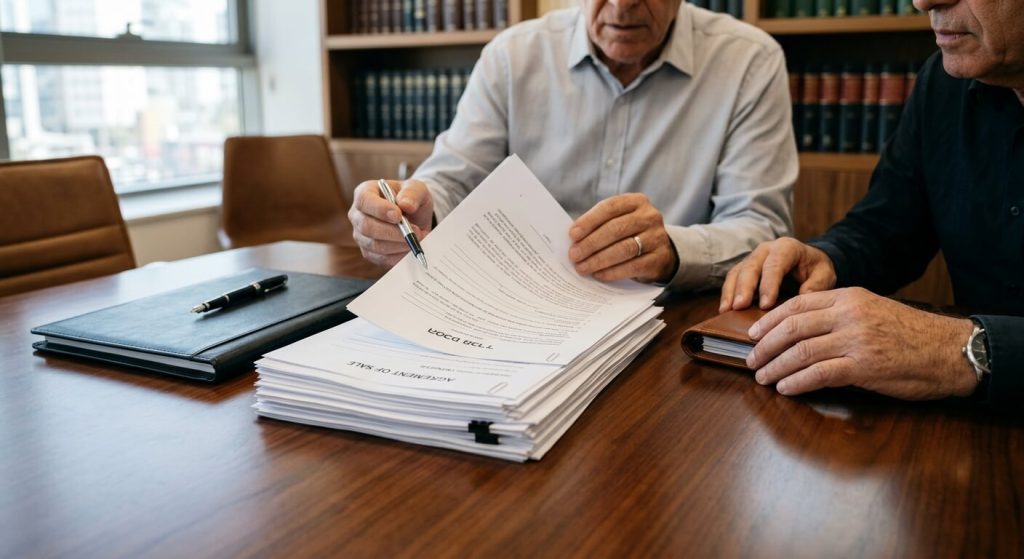
A notary (an Israeli notary public) is an attorney with 10 years of experience. A notarial certificate is essentially a notary’s signature on a document, in which the notary confirms the identity of the signer, his signature, and the fact that the signer understood the meaning of what he signed.
Signature authentication by a notary is a higher level of reliability than ordinary authentication before an attorney. Therefore, in many cases authorities, courts, government institutions and various bodies – both in Israel and abroad – insist that the signature be authenticated by a notary and not by an attorney. A notarial certificate is considered admissible and reliable evidence in court.
When Is a Notarial Certificate Required?
A notarial certificate is required in a wide range of cases, in the civil sphere as well as in the commercial or international sphere. Here are several common examples:
Signature authentication: When it is necessary to verify that the signature on a particular document was made by the right person and under proper circumstances, for example: authenticating a signature on a notarial power of attorney to a bank when taking out a loan, or authenticating a signature on a notarial power of attorney to the housing company for the purpose of registering the tenants’ rights upon registration of a condominium.
Certified true copy: When presenting official documents (such as birth certificates, ID cards, academic certificates), it is sometimes required to submit a copy certified by a notary.
Certified true translation: When a document is translated into another language, for presentation abroad or before an authority, it is necessary to ensure that the translation is accurate and matches the original.
Life certificate: Retirees who receive pensions from abroad are sometimes required to prove that they are alive in order to continue receiving the pension.
Power of attorney to another person for the sale of real estate: a document that grants another person the authority to act on behalf of the signer irrevocably, for example when selling a real estate property.
Certification of prenuptial agreements: Couples about to marry who wish to arrange in advance the division of property between them are required to obtain a notarial certificate for the prenuptial agreement – subject to the Spouses (Property Relations) Law.
Who Is Authorized to Issue a Notarial Certificate?
The authority to issue notarial certificates is vested exclusively in a notary – an attorney with at least 10 years of seniority, who has received notary certification and a notary license from the Ministry of Justice. In addition to seniority, the applicant must have a clean record, complete a dedicated course, and meet the requirements of the law. The notary is subject to the Notaries Law, 5726-1966, and acts in accordance with professional and ethical guidelines. The notary is responsible for ensuring that the parties sign with full understanding and without coercion, and that the document or its copy matches the original.
Types of Notarial Certificates
Here is an overview of the common types of certificates:
Signature authentication: The notary verifies the person’s identity, explains to him the content of the document, and only then confirms his signature. This certificate is most often required for powers of attorney, contracts, and legal declarations.
Certified true copy: Required when a copy of an original document must be submitted, for example to a university, a government authority, or a court. The notary compares the documents and confirms that the copy is accurate.
Certified true translation: A certified translator translates the document, and the notary confirms that the translation was done faithfully to the original. This is common when submitting documents abroad or to embassies.
Life certificate: The notary meets the person, identifies him, and confirms in an official document that he is alive – usually at the request of international bodies.
Certification of an irrevocable power of attorney: A legal document in which the principal grants irrevocable authority to act on his behalf, for example in real estate transactions. The notary has a role in ensuring that the signer understands the legal implications.
Certification of prenuptial agreements: These agreements, which are signed before the marriage, require a notary’s certification in order to be valid. The notary ensures that both parties understand the agreement and signed it willingly.
How much does a notarial certificate cost? – Updated for 2025
Notarial certificate fees in Israel are regulated and set every year by the Ministry of Justice. VAT must be added to the fees below:
Signature authentication: 189 NIS for the first signer, and 75 NIS for each additional signer.
Certified true copy: 75 NIS for the first page, and 13 NIS for each additional page.
Certified true translation
Up to 100 words: 245 NIS
For every additional 100 words up to 1,000 words: 189 NIS
Over 1,000 words: 96 NIS for every additional 100 words.
Additional certificate (copy): 75 NIS.
Life certificate: 193 NIS.
- Additional costs may apply in exceptional cases, at unusual hours, or for service outside the office.
What Is an Electronic Notarial Certificate and What Is an Electronic Notarial Signature?
In recent years, following advances in technology, it has become possible to issue an electronic notarial certificate – a legal document signed with the notary’s secure digital signature. It is an online document, stored securely, and it can be sent by email or through secure online systems.
The Main Advantages of an Electronic Notarial Certificate:
- Time savings – no need to physically come to the notary’s office for every action.
- Convenience – the certificate can be received from anywhere in Israel or around the world.
- Environmentally friendly – reduced use of paper and ink.
- Security – a secure digital signature that includes a timestamp and protection against forgery.
An electronic notarial signature is a technology that verifies the identity of the notary and ensures that the document has not been altered since it was signed. Every such signature is made using a dedicated smart card issued to the notary.
At the same time, it is important to know that not every type of certificate can be issued digitally. There are documents or situations in which the physical presence of the signer before the notary is still required, for example when strict personal identification is needed.
Summary
A notarial certificate is an essential legal tool in a variety of areas – from submitting documents to authorities, through real estate transactions, to settling personal and family matters. Any person or entity that needs to ensure the reliability of a document, legal protection, or compliance with the requirements of the law will find in the notarial certificate a fast, simple, and recognized solution. It is important to turn only to an authorized notary, follow the requirements of the law, and make sure that the certificate is carried out professionally, whether physically or electronically. This way you will ensure that your documents are valid and protected – anywhere and at any stage. We would be happy to assist you with any question.