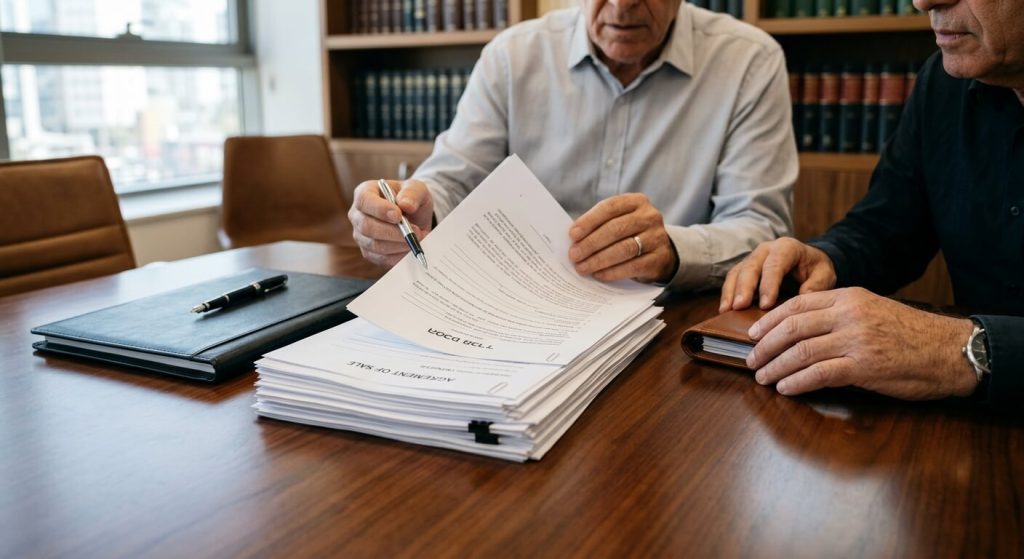
When a person wishes to determine in advance what will be done with their property after their death, one of the safe, accepted and hard-to-challenge ways to do so is through a notarial will. This type of will, unlike other wills, is prepared by a notary who verifies the testator’s capacity, their full understanding of the process, and the document’s compliance with the law.
In this article we will review what a notarial will is, what its foundations are, how the registration and delivery process works, what its advantages are, what the possible defects are, and how an objection can be filed or action taken to revoke it if necessary.
Notarial Will – What Is It?
A notarial will is one of the four types of wills that exist under the Succession Law in Israel. It is a will made before a notary, who is an attorney who has held a license for at least 10 years and who has been authorized to do so by the Ministry of Justice.
The notary reads the contents of the will aloud to the testator, verifies that the testator understands its meaning, signs it together with the testator, and confirms with his or her signature that the person was found competent to make a will.
A will of this type is considered very strong evidence of the testator’s wishes and has the force of an official document, almost equivalent to a court judgment, and therefore it is very difficult to challenge.
What Are the Foundations of a Notarial Will?
For a notarial will to be valid, it must meet several basic principles:
Legal capacity of the testator – the notary must verify that the testator is in a sound mental and physical state, understands the meaning of the will, and is not acting under pressure or outside influence.
Declaration of the testator – the person who wishes to make the will declares their wishes before the notary.
Notarial authentication – the notary reads the will aloud to the testator, verifies that the testator approves its content, and then certifies the document with his or her signature and official seal.
Registration of the Will and Its Delivery to the Testator:
After the will is drafted and approved, the notary keeps a copy of it and issues the testator an official copy of the will. In addition, by law, it is possible and even recommended to deposit the will in the Ministry of Justice’s database (the Registrar of Inheritance), which ensures that no one will be able to conceal the existence of the will after the testator’s death.
Delivery to the testator is accompanied by detailed explanations of the legal meaning of the document, and the notary may even add protocol notes in special cases, such as where there is a certain medical or cognitive limitation.
What Are the Advantages of a Notarial Will Compared with an Ordinary Will?
1. Particularly strong evidence – the presence of a notary ensures that the will was written and signed lawfully and knowingly, which prevents future claims of coercion or lack of understanding.
2. No need for witnesses – unlike a will made before witnesses, there is no need for witnesses to testify about it when the will is probated, since the notary serves as an authorized “legal eye.”
3. Protection against forgery or error – the document is signed and kept by an authorized professional, and the fact that it is registered in the state’s wills database prevents the possibility of making it disappear.
4. Great difficulty in revoking or challenging – invalidating a notarial will requires weighty evidence.
Material and Formal Defects in a Will – When Is This Relevant?
Even a notarial will, despite its strength, may be invalidated if there are material or formal defects:
1. Mental incapacity of the testator – if it is proven that the testator was not lucid or of sound mind when the will was made, it can be argued that it is void.
2. Undue influence – if the testator acted under pressure, manipulation or exploitation by another party.
3. Technical error by the notary – for example, if the notary did not meet all of the requirements set by law, such as accurate documentation of the testator’s declaration.
4. Signs of forgery or internal contradictions in the will – inconsistent content, unclear wording or signatures that appear forged may raise questions.
How Is an Objection to Such a Will Filed?
An objection to a notarial will is filed in a proceeding in the Family Court, after an application for probate of the will is submitted to the Registrar of Inheritance. Anyone who wishes to object must file a reasoned statement of objection together with evidence that the will is not valid.
The objection may be based on:
- The testator’s lack of capacity.
- Undue influence by a beneficiary of the will.
- Claims of forgery or improper registration.
The making of a later will that revokes the current one.
In such cases, the court will decide whether the will is valid or must be revoked.
Revoking a Notarial Will – Is It Possible?
Yes, a notarial will can be revoked, just like any other will, as long as the person is still alive and legally competent.
Revocation is carried out in one of two ways:
Making a new will – a more recent will revokes all prior wills, unless stated otherwise.
Declaration before a notary – one may declare the revocation of the will before a notary, in a lawful and authorized manner.
After the testator’s death, the notarial will cannot be revoked, unless it is proven that it contains a material or formal defect, as stated above.
Summary:
A notarial will is a reliable legal way to ensure that a person’s property will be distributed in accordance with their wishes after death. It provides legal certainty, reduces family disputes and includes many protection mechanisms against forgery or invalidation claims.
At the same time, it is important to make sure the will is made by a professional, authorized and experienced notary in the field – in order to prevent unnecessary errors or defects that will lead to legal disputes in the future. In case of doubts, disputes or suspicion of undue influence, one should turn to an attorney for inheritance matters and act in accordance with the legal procedure set by law.
Drafting a will involves many important details, the absence of which could invalidate it. It is recommended to turn to an attorney or notary, who can write the will in a legal manner, will pay attention to the small details, and will prevent – heaven forbid – a dispute among the heirs, aggravation, court battles and unnecessary financial expenses. We would be happy to assist you with any question.